RECRUITMENT HEALTH

What is recruitment health?

Hiring is a system, and like a body it can look fine while running badly: searches take longer, wrong hires get through more often, good people leave sooner. Recruitment health is the physical for that system — speed, accuracy, retention, and what each costs when it is off. Most companies feel it. Almost none measure it.

Introducing
Recruitment Health Index
An industry first by PHM Search

RIQIndex™ measures your company's recruitment health across nine markers and reports what it is costing you: an estimated annual recruitment cost, the five drivers behind it, and a clear view of what a search firm can fix. Fifteen minutes of your own answers — free for the founding cohort, confidential, and yours to keep.

Score and Index

A score is what you get. An index is what the scores add up to.

They are different things, and the difference matters — both to what you receive and to what is being built.

What you receive

Your score

One measure of how your recruitment system performs, across nine markers — returned as a cost, the five drivers underneath it, and the pressure points producing them.

What is being built

The Recruitment Health Index

The aggregate benchmark assembled from many scores. It is what turns your number into a comparison — how you stand against companies of your size, in your sector, hiring the same kinds of people.

One score is not an index — which is exactly why the first companies through matter more than the hundredth.

Who it’s for

Written for the people who carry the cost of a hire, not the ones processing it.

The assessment asks you to grade your own organization, so what comes back is how the system looks from where you sit. No single seat sees all of it — which is why this is written for people close enough to the numbers and the strategy for a partial view to still be a useful one. Whether the rest of the table sees the same thing is a later stage of the work.

Founder / CEO

The growth plan is a hiring plan under a different name. When roles stay open the plan slips, and it is almost never recorded as a hiring failure.

COO

Vacancies reach you as delivery risk. You feel them as slipped schedules and stretched teams long before they surface as a recruitment number.

CFO

The cost is real and sizeable, and it rarely appears as a line item. It sits inside overtime, contractor spend, deferred revenue and turnover.

CTO / VP Engineering

The scarcest skills and the longest time-to-fill. One unfilled senior seat can hold a roadmap for two quarters.

CHRO / VP People

You own the system and usually already know where it leaks. What is missing is a number that makes the case to the rest of the table.

Heads of function

Whoever owns both the budget and the outcome for a function’s hiring. In many companies that is not a chief officer, and the score is still yours to take.

Answering honestly has to be safe

You are being asked to mark your own organization, and a flattering answer produces an unuseful score. That is only a reasonable request if the answers stay yours.

Your score is returned to you and to nobody else. It is not published, not sold, and not shown to anyone inside your organization who did not receive it from you. Nothing we produce attaches your company name to a number.

Contributing to the Index is a separate, optional consent, and it runs on anonymized and aggregated responses only. Decline it and you still get your score.

The question everyone asks second

Almost every leader who sees their number asks the same thing next: how does this compare with everyone else in our market?

That is the reason for an index rather than a report. Not a national average, but the firms you actually lose candidates to — the ones hiring the same people, in the same sector, at the same scale — and the full Index behind them.

Those comparisons do not exist on day one. They exist once enough scores do, which is what the founding cohort is for.

On company size

In larger organizations these responsibilities sit a level down — SVP, EVP or VP of Operations, Finance, Technology or People. The title matters less than the vantage point: you should be able to see how a role gets filled and what it costs the business when it does not.

What you get

A number, the pressure behind it, and an honest split of what we can fix.

01

The number

An estimated annual cost of your current recruitment health — a range, decomposed into five drivers, each anchored to published research and cited. Two of them, vacancy drag and mis-hire cost, you can estimate yourself first.

02

Where the pressure sits

Nine factors of the recruitment system, each returned as a band rather than a mark — and what is working, not only what is not.

03

What we can and cannot fix

Six of the nine we move ourselves. Two we improve inside a single mandate. One stays with you. The report says which is which.

Read the sample report extract
RIQIndex_Sample_Report.pdf — illustrative figures
Estimated Annual Cost of Current Hiring Health
$680K – $1.24M
1.7% – 3.1% of estimated annual revenue. Range derived from research-anchored cost benchmarks (SHRM, Gallup, WEF, Mercer) applied to your organization’s profile. The width of the range reflects the absence of operational data that direct measurement inside the organization would provide.
Cost drivers
Driver
Estimate
Research anchor
Vacancy Drag
$210K–$390K
SHRM 2023 · Dr. John Sullivan
Mis-Hire Cost
$180K–$330K
SHRM · U.S. Dept. of Labour · Josh Bersin
Talent Premium
$120K–$220K
WorldatWork · Mercer
Workforce Strain
$105K–$190K
SHRM 2023 · Gallup
Capability Erosion
$65K–$110K
WEF Future of Jobs 2023
This is an extract. The full report runs to twelve sections — what’s working before what isn’t, the nine symptoms ordered by severity, the reinforcing patterns between them, the consequences each driver carries, and the methodology in full — including where your score will sit against the Index once the founding cohort completes it.
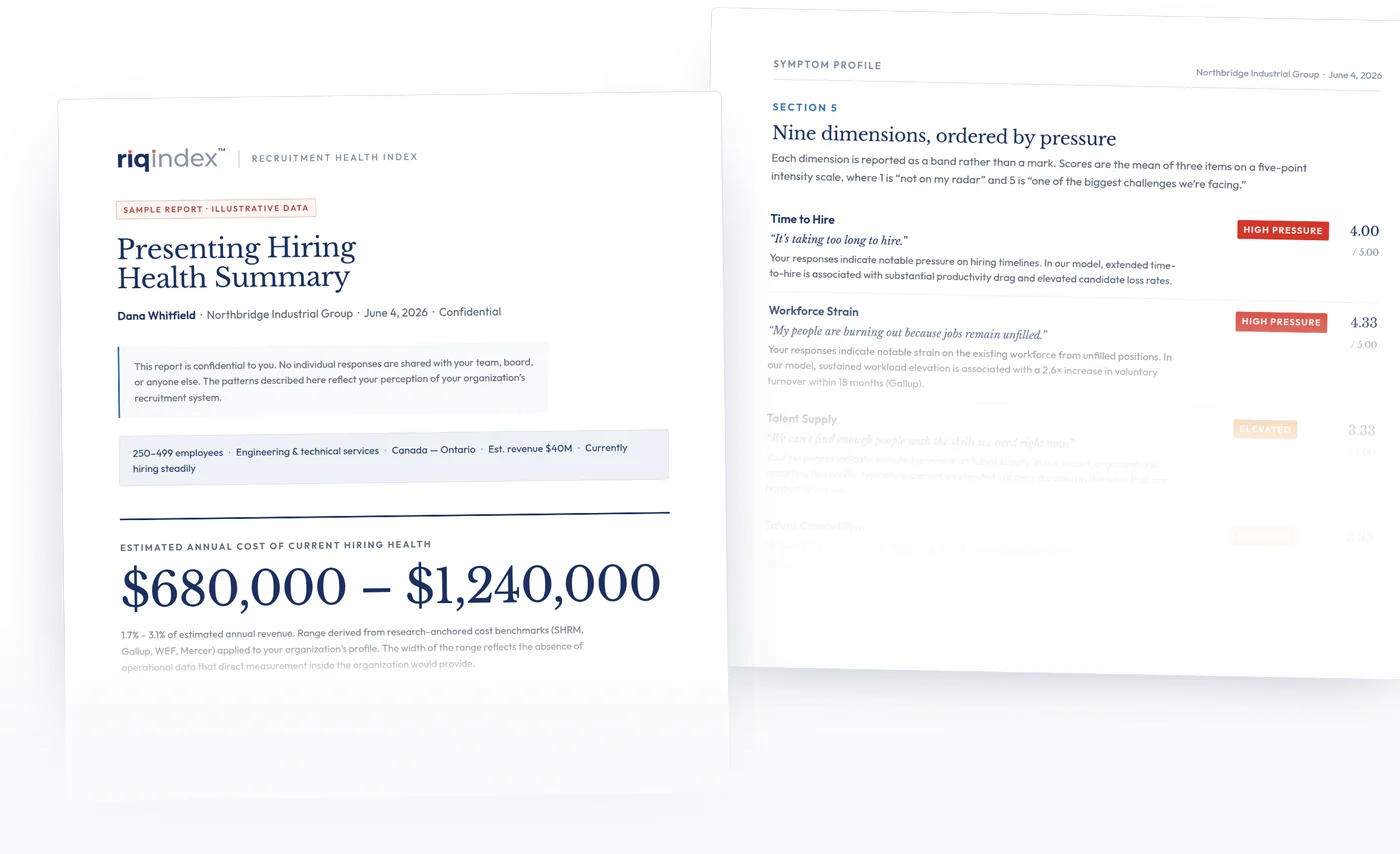
Pages from a sample RIQIndex report: the cover with an estimated annual cost of current hiring health, and the symptom profile listing markers with severity bands and scores
Pages from a sample report. Figures, names and scores are illustrative.
Time
Under 15 minutes
Cost
Free — founding cohort
Built for
50–1,500+ people
The result
Yours to keep
Where PHM comes in

RIQIndex™ uncovers the system costs. PHM addresses the most expensive part of it.

Of the nine markers RIQIndex™ measures, our recruitment services directly move six — for your senior and business-critical roles. Two we improve at the level of an individual mandate. One is yours to run, and your report shows you where.

Talent SupplyDirectly solves
“We can’t find enough people with the skills we need right now.” Research, market mapping and active sourcing into passive candidates who are not applying to anything.
Time to HireDirectly solves
“It’s taking too long to hire.” Pre-built networks and live pipelines compress time-to-fill on the roles we run — straight against the per-week cost of an open senior seat.
Talent CompetitionDirectly solves
“Everyone is competing for the same talent we need.” Reach into people who are not in the open market, plus live compensation intelligence to position an offer against what competitors actually pay.
Candidate LossDirectly solves
“We lose people we need before we can hire them.” Candidate engagement through the process and hands-on offer management — closing first-choice people before someone faster does.
Mis-Hire ImpactDirectly solves
“Bad hires are costing us time and money.” The core of the service: structured assessment against a scorecard and a rigorously qualified shortlist.
Workforce StrainDirectly relieves
“My people are burning out because jobs remain unfilled.” Two ways — the roles get filled, and the sourcing, screening and coordination come off internal desks.
Compensation PressureMandate level
“People expect more money than we’d like to offer.” Real-time data on what candidates are accepting, and offer structuring against it. The budget itself stays a leadership decision.
Decision UncertaintyMandate level
“We’re second-guessing our hiring decisions.” A structured intake, a scorecard and a calibrated shortlist give the decision a framework. On searches we don’t run, that framework is yours to build.
Skills DisruptionYours to run
“The skills we need are changing faster than we can hire for them.” We see which skills are moving and advise accordingly, but workforce and skills planning is an internal strategic function.

The six we move are the work itself: executive and leadership search for the roles at the top of that list, and specialist and senior recruitment for the rest.

We are not the fix for all nine. Claiming that would make the honest parts sound like sales too. We take on the part that costs the most to leave unsolved — and your report tells you whether that is where your pressure actually sits.

What it is, and what it isn’t

It measures what you see. That is the point, and the limit.

RIQIndex™ is answered by the people running the business, and it reflects their view of the recruitment system faithfully — including the parts they are closest to and the parts they are furthest from.

That makes it fast, honest and genuinely useful. It also makes it a measure of perception, not an operational audit. The two are usually close. Where they are not, and the gap concerns senior capability, the placement itself is usually the fastest way to resolve it.

We would rather tell you that up front than let the number carry more weight than it should.

The founding cohort

An index with one score tells no one anything.

A benchmark needs roughly a hundred scores before it can say what “normal” looks like for a business like yours. Until then there is a score, and it is genuinely insightful — but it is not yet a comparison.

So the first hundred companies are not early adopters getting a discount. They are what constitutes the Index. Their scores are the baseline everything later is measured against — and that is only true while the number is small.

We would rather say that plainly than pretend a benchmark exists before it does.

Launch list

Join the launch list. Your score is the first thing you get.

RIQIndex opens to the founding cohort first — the first hundred companies on this list. It is not live yet: add your details and we will send you the assessment, and a time to walk through your score, the moment it is. There is no cost, obligation, or follow-up sequence you have to escape from.

Where the cost sits in senior hiring, that is our work and we will say so. Where it sits deeper in the system, we will say that too — a diagnostic that only ever recommends its own author is not diagnosing anything.

Your details and your score are confidential. Neither is shared, sold, or published — the Index is built from aggregate scores, never from identifiable companies.
Launch list form

Fields marked * are required.

PHM Search is the executive search practice behind RIQIndex™. RIQIndex™ is a trademark of HIQGroup Inc., used by PHM Search under licence. Your responses are held by RIQIndex™ and are never shared in identifiable form.

Common questions

Recruitment health, answered.

What is recruitment health?

How well your hiring works as a system rather than role by role. RIQIndex™ scores nine markers and converts the result into an estimated annual cost.

What does it cost, and how long does it take?

Nothing for the founding cohort — the first hundred companies — and under fifteen minutes to complete. We expect to charge for it after that, though no price has been set. The score and report are yours either way.

Who should answer it?

Someone who sees what hiring costs and what it delivers — typically a founder, chief officer, or head of a function that hires.

Who sees my score?

Only you. Nothing is published or sold, and your company name is never attached to a number. Adding your data to the benchmark is a separate, optional consent.

Is this a recruitment audit?

No, and the difference matters. A recruitment audit is an operational review — someone inside your data, your ATS and your process, measuring what actually happened. RIQIndex™ is answered by you, in fifteen minutes, and measures how the system looks from the seat that carries its cost. It is faster, and it is honest about being a measure of perception rather than an audit.

How is this different from a cost-per-hire calculation?

Cost per hire tells you what one hire cost to make. It does not tell you what the roles you never filled, the hires that did not work out, and the people who left early are costing you — and those are usually the larger numbers. RIQIndex™ estimates your whole annual hiring cost, not the price of one transaction. If you want to sanity-check two of the five drivers yourself first, the cost of vacancy calculator and the cost of a bad hire calculator do exactly that.

Is this a sales assessment?

No. The report names the areas we cannot help with as clearly as the ones we can. Two of the nine sit outside what any search firm can move.

What happens after I get the score?

A walkthrough, if you want one. Whether the fix is a search or something internal, we will tell you which.

Or start with a conversation

Not ready for the assessment? Talk to us anyway.

If you would rather describe the problem than measure it, that works too — the assessment is a way in, not a gate.